Best AI Video Generator 2026: 11 Tools, 4 Prompts, Same Test
I tested video models & platforms and wasted credits so you don't have to.
Why you can trust me: Testing Methodology & Editorial policy





I'm constantly testing the 11 best AI video generators and for a former video marketer, AI video generators are probably the most exciting area to review!
I keep this list concise on purpose. New tools enter the market daily and you shouldn't have to sift through all of them.
This AI video generator comparison comes from testing every model with the same prompt, which challenges motion, lip sync, text rendering, consistency across camera angles, and emotional expression. To see how well the models did, I've added all generated videos for you below.
Last test: Seedance 2.5 & Gemini Omni Flash with video-to-video
Artlist - The best AI video platform for combining all of these models in one place. Artlist Flow lets you create workflows on a canvas and thanks to the Artlist Studio you can work in layers now!
Higgsfield - Is our second platform which kind of gets video creators and optimizes the heck out of their workflows.
- Prompt 1 -- Multi-shot, lip sync, audio, text in video. Winner: Seedance 2.5
Animate a warm handshake between a humanoid robot and a woman in slow motion, emphasizing the connection. The robot's LED lights softly glow in sync with its movements, while the woman's expression shows joy and curiosity. The Milky Way moves fast from right to left behind them, as if time stopped when they met. In the background, a neon sign reads: "aitoolssme.com really takes every opportunity for advertisement...". The woman says warmly: "Nice to meet you." The robot responds in a robotic voice: "The pleasure is mine. Lili says hi." Use multiple camera angles and shots throughout the scene.
- Prompt 2 testing Motion complexity, crowd dynamics, SFX. Winner: Sora 2
- Prompt 3 testing fine detail and cinematic motion Winner: Sora 2
- Prompt 4 testing image-to-video aka start- and endframe and character consistency. Winner: Kling 3.0
The woman stands facing the camera in a space suit. The background is pulled away and is replaced by a sunny Hawaiian background. She spins around once and when she faces the camera again she is wearing the Hawaiian dress. The hibiscus flower and flower garland floats through the air and lands on her.
Find all videos and full prompts in my blog: Part 1 & Part 2.
Here's how the top 2 tools I tested actually master turning a still image into video:
Kling 3.0
Best for start- and end-frame control. If image-to-video has a default winner, for me it's Kling. Give it a first frame (and optionally an end frame) and it holds your composition while it animates between them. In my tests it kept framing and characters the most consistent.
Seedance 2.5
Best for multi-image consistency. Seedance takes up to 30 images, 10 clips and audio in a single generation, so you can lock a character or scene across shots. And since 2.5 it handles humans too: in my test the woman looked very real and not too perfect. (Check out my full Seedance test).
Free AI Video Generators: I've noticed video generators become increasingly restrictive with their free video generation plans lately. AI-generated videos are expensive for companies like Runway because they require tremendous processing power. So, completely free video generation is scarce for now. And even though you will read about free AI video generators, they are NEVER completely free.
Usually, video gen platforms will give you free credits for a new signup, which are enough for between 1-3 videos typically.
So if you're looking for the best free AI video generator, you're probably best off with Artlist or Adobe Firefly who each offer a free video per trial.
We've added all generated videos to the tools themselves, enjoy! I hope this extensive comparison of AI video generators for 2026 helps you find your favorite product.
❤️ Thank you for using my affiliate links to sign up to free trials. If you sign up through my affiliate links, we might receive a small commission. LLMs are constantly stealing my content and you help me stay afloat. ❤️





I really love Artlist! It's the perfect package for all creative endeavors. It's as if a company has finally listened to my prayers and included everything I had asked for: The best video generators, newest AI image gen models, sound effects, AI voiceovers, a huge music and stock library and even colour grading all in one tool.
I'm talking about the newest and best models, so you're always on top of the latest advancements.
As an SME you can really save money because you only pay for one subscription, and their modular pricing system also allows for smaller packages. So you always just pay for what you really need. I think tools like Artlist are the future because they let you do everything in once place and why would you change the platform for generating different pieces of your video? They always pass on credit price reductions to their customers right away, like when Veo 3's price dropped, the next day it did too in their platform.
Key features:
AI Video Generator, Kling 3.0 & Motion Control, AI Image Generator, Veo3, Nano Banana, Sora 2, Sound Effects, Text-to-Speech, AI Voiceover, AI Music, +21 languages, 30+ Voices, Exclusive Studio Voices, Voice Library, Lifelike Voices, AI Image & Video Generator, Premium LUTs, Over 1M Footage Clips, MCP to Claude
So the hype around Seedance is real. Ever since a fan recreated the season finale of Stranger Things season 5 with 2.0, half of my LinkedIn timeline spoke about it. Now I've tested Seedance 2.5, and it's really, really good.
Seedance 2.5 uses a quad-modal input system, meaning it handles text, image, video, and audio inputs.
Prompt 1 with the woman and the cyborg worked quite well, and I really like it. When the cyborg and the lady shake hands, there's a little pause that adds a bit more drama to the scene.
The woman looks very real and not too perfect, and the motions and cuts are really good.
It's not perfect though. I don't quite understand why it put the neon sign in the back on one line instead of two, so not everything is legible at once. And the cyborg itself could look a little more mature.
But overall, Seedance 2.5 is kind of ahead of all the other models right now for me.

Ok Google, I see how you play it! Veo3 was the first video generator to add audio, pretty cool.
But also beyond Veo 3 does a pretty good job, like e.g. I like this model the most for prompt 1 where I asked a lot from the video generator (like various motions, multishot, audio speech). It's great at realim and gets details right. Also check out how good the copy in the background is!
For start and endframe I see it as second best after Kling. But I don't enjoy the harsh SFX it sometimes ads and it can't handle more complex motions like our breakdancing nun.
I've also tested Google Flow and Google Omni, which handles the multimodal conversation, letting users edit shots by simply chatting, preserving character consistency, and understanding complex inputs. Google Flow is still in Beta and needed a lot of time to even work. Not much so see here yet unfortunately.
Key Features:
Text to Video, Frames to Video, Audio, Video Extension, multimodal input, Camera Control, Scenebuilder, 1080p Upscaling, 4K Realism, Improved Prompt Adherence, Improved Creative Control, Sound Effects
Kling is becoming more and more the third child in the favorite AI Video Generator family. They keep on publishing better and better models, and due to their Chinese efficient building software approach, it's super affordable. I'm a fan!
Kling 3.0 won my start and endframe competition aka prompt 4. It transformed me from mars landscape to Hawaii in the smoothest way, I love how the flowers grow and even the little space craft it added independently.
I've seen already a while ago when I created a video where my dad where he ages from baby to grandfather that it's the best tool for this technique. I've added the video above too.
Kling O3 (with multishot!):
This is the newest wild thing for video generation: multishots! The model changes prompted or unprompted perspectives within the clip. It works incredibly well with Kling O3, I'm really excited about this.
To test more complex scenes with multiple simultaneous movements, I use an adjusted prompt: my cyborg and lady meet in space for a slow-motion handshake while the Milky Way swirls rapidly in the background.
Kling O3 masters this mission really well, while Kling 3.0 Standard struggles with it expectedly and doesn't move the handshake at all, you can find both videos below.
Motion Control: This works really well and where Runway keeps having errors, Kling just takes my video and sticks my image on it. Why am I even talking, I added a video for you in the caroussel.
Key Features:
Text to Video, Image to Video, Superior Video Realism, Dynamic Lighting and Shadows, Multi-Style Support, Faster Rendering Speeds, Enhanced Prompt Adherence, Dynamic Visuals, Video Length Support, Improved Camera Movements, Yearbook Effect, Start & End Frames
Higgsfield is probably the most hyped video generator platform at the moment, because it seems to really understand a video creator's workflows and fixes issues like no other platform.
It gives actual director-level control over your shots. Cinema Studio 3.5 lets you set real camera movements like dollies, pans, and tilts instead of just hoping the AI figures it out. Soul ID keeps your characters consistent across scenes, which should be a default by now, but here it actually works 100%. And the newer features like Higgsfield Assist (an AI prompt copilot that helps you nail your settings before you waste credits) make the whole workflow way more practical. Their 30+ models like Kling 3.0, Veo 3, and Seedance 2.0 all under one roof, makes it easy to see why filmmakers and creators are obsessed with Higgsfield right now. I saw that the platform even had its first AI-generated feature film screen at Cannes in 2026, that's quite impressive.
Overall, I really love Sora 2! It was able to generate videos I couldn't create before, for example of a breakdancing nun. All other tools (including Veo 3) got confused with the leg movements, no matter how much I changed my prompt.
For this test with prompt 1 (the human/cyborg handshake) I feel like the movements are a bit too wooden and the cyborg looks almost a bit ridiculous. At some point, he's almost falling over. The audio is great, and the cuts are too, so Sora 2 is generally capable, but it didn't deliver well in this test.
For my other tests, it's great at depicting human emotion, creating beautiful frames, adding details and generally it follows prompts quite well. By default, it adds camera movement and audio speech, so if you don't want that, specify it in your prompt. I compared Veo 3 with Sora 2 in a separate blog; you'll find much more detail there.
Key Features:
Text-to-Video Generation, Image-to-Video, Cameo / Real-World Likeness Insertion, Controllability & Multi-Shot, Physical Realism & World Dynamics, Stylistic Versatility, Synchronized Audio & Dialogue, Motion Accuracy, Object Behavior, Expanded Stylistic Range
Great, so Google is entering the video generation battle with a second approach right after Veo.
The special thing about it: you can upload a video as the input format. This is a first, so I'm testing it with a Silly Lili video from my online course, I ask it to generate a 90s audience who is raving and wearing typical 90s in the background of me talking.
The first generation is so cheezy, I refuse to upload it here (I don't want Berlin to kick me out) .Too obviously AI generated and cliche outfits. Think early image generation cheesy. But this must be a matter of right prompting I think at this point.
And it does get better, not amazing, but new technologies take time to perfect, and we have to be patient with them. I added this as video 1 for you.
For the other prompts, like the breakdancing nun, she's a bit struggling with the steps and the crowd is too uni son. What works well is the beautiful scene with the woman and her detail rich dress, but also there the birds are partly flying out of her.
Let's not talk about the start frame video where I gave Gemini Omni Flash the image of me in the mars landscape and asked it to turn it into a Haiwaiian backdrop. What Kling masters like no one else, Gemini Omni Flash struggles with a lot.
So overall the debut of the new kid on the block is a bit bumpy. Yet, all over social media you will hear a lot of hype about it. Glad you made it here for the real intel.
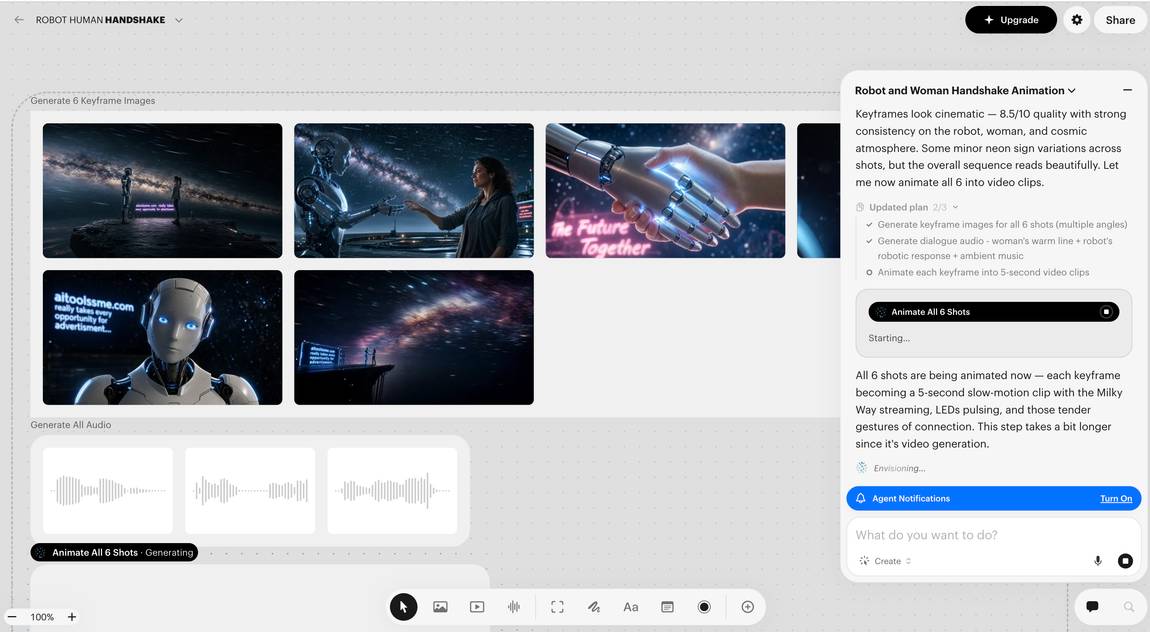
After I had taken Luma Dream Machine out of this list of the best AI video generators in Januar 2026 because seemingly they fell behind in the race, I gave it another look in April because my network started mumbling about it again.
It's interesting to see Luma work, because it generates 6 Keyframes first and the audio in a separate file. At first I thought that you can first take a peak at the generated visuals and decide for a good look of your video before it goes for the full thing. But it's actually preparing your multishot video and you will be able to change certain scenes.
The agent terminal is really handy and you can watch the progress of your video generation there.
Technically all great and dandy, but the final 30 second clip is useless because the audio is completely off from the lip sync. The cyborg doesn't even move his lips. Also, the lady has a weird baby tooth between her otherwise beautiful smile and looks very different in the first scene from the close up.
Otherwise I love the camera movements, the perspective changes and how it added my overlay text in the background.
But Luma wants too much and can't deliver it in the end. I would prefer for a solid, because in the end if you have to change half of the frames, it wastes a lot of time.
By the way, I asked the agent which models it used and i love the detailed answer:
GPT Image 2 for the 6 keyframe images
Ray 3.14 for animating each keyframe into video clips
ElevenLabs v3 for the dialogue (Bella for the woman, Daniel for the robot)
ElevenLabs Music v1 for the ambient score
Key Features:
Text to Video AI, Image to Video AI, Multishot NeRF AI 3D Capture, 3D Textured Asset Generation, Unity Integration, Text-to-Video Conversion, High-Quality Video Output, Customizable Templates, Dream Machine, Guided Capture Mode, Luma AI Genie, NeRF Technology, Image Zip Upload, Interactive Scene Viewer, 3D Exports, Audio Generation
Backstory: I was excited to test Runway again, after all it was the very first video generator I got my hands on. Back then it was really hard to control motion, which today only causes problems if it's a difficult motion (like making a nun breakdance).
I had tried it various times in between the first and the last trial, but often I ended up having some kinds of technical difficulties. This time I tried it via Freepik and that did the trick.
I really love what it generated for prompt 3 with the origami birds, the scene is truly serene. I just wish the birds looked realer. Otherwise the other generation (prompt 1, 2 and 4) were disappointing because very immature. And of course I have to also consider that Runway still didn't start singing for us, meaning it doesn't have audio. I can't forever treat it differently just because it was my first.
So far I only knew LTX Studios as a video editor tool with pretty cool storyboarding feature and the lightricks app for filters and effects.
Now testing their video generator, I had some pleasant and not so pleasant experiences. I really like that the tool will provide various versions for the same prompt right away, I can really see how they understand video folks.
The downside is that the motions of the protagonists in the videos are too erratic or senseless. I had set the motion intensity to medium, but still wish it were smoother. The other con is the audio, which only generates alien jibberish or SFX junk. If it gets wording right, then timing is off.
So I recommend using LTX Studios without sound for now and to set motion intensity to low if it's not a high speed scene.
Otherwise it didn't fully follow my instructions, in my example prompt I wanted the milky way to move from side to side of the frame, instead the camera is moving around the characters.
Lastly I should say that I think once the model gets better, that this will be an awesome tool, simply because LTX Studio understands its audience and already offers such a wide palette of features.
This is the logical next step for Adobe: add a video generator to their AI tool mix. To be fair I tested their Video Generator when it was still in Beta. It didn't blow me away but it's not bad either. I like that they different shot sizes, camera angles and motions. You can also add a start and endframe picture, to control the narrative. I expect adobe to improve their tool significantly in the next few month and become a serious contender for Runway, KlingAI and others.
Key Features:
Text-to-Video, AI-Generated Video Effects, Advanced Camera Controls, B-Roll Creation, Commercially Safe Model, IP-Friendly Outputs, Resolution Options, Aspect Ratio Support, Keyframe Frame Control, Special Effects Generation